Most of what is written about Sankofa in English is wrong. Not maliciously — usually it is wrong because Sankofa resists translation, because the concept does not match neatly onto Western categories, because the writers are working with a sentence-long summary instead of a tradition. A Praise-Poem for Sankofa? This essay is one attempt at a more careful answer.
What Sankofa Actually Means
The most commonly cited definition: Sankofa is an Akan word and a symbol — most often a bird with its head turned backward, holding an egg in its beak. The egg is the future; the head turned backward is the past. Together they teach a simple, demanding idea: it is not wrong, nor shameful, to go back and fetch what you forgot. The future cannot be built on amnesia. That sentence is true, as far as it goes. It is also incomplete. Sankofa is held inside a wider Akan grammar — a set of related concepts, social practices, and proverbs — that the standalone definition cannot carry.
The past is not behind us — it is beneath us.Akan saying
The Question This Post Is About
An imagined praise-poem for Sankofa — and the Akan tradition of using praise to teach. The question is worth taking seriously, because Sankofa is one of those concepts that loses its shape when handled carelessly — and recovers it as soon as the reader is willing to slow down and listen.
Consider one of the central sayings in the tradition behind Sankofa: "The past is not behind us — it is beneath us." — translated above. It is the kind of saying that English readers tend to admire and then forget. The Akan reading is more demanding. Before changing a long-running practice, the team asks an elder of the practice what it was for. The proverb is not decorative. It is instructional. It has been carried for generations because it solves a problem that does not stop being a problem — a problem the modern reader still meets, every week, dressed in newer clothes.
A Second Angle
Read alongside it: "The past is not behind us — it is beneath us." The two sayings are not redundant. They sit at different angles to the same idea. In Akan oral tradition this is a common pattern: a concept like Sankofa is not given a single canonical definition but a family of proverbs, each holding part of the meaning. You learn the concept by living with the family of sayings — not by mastering one of them.
Where the Concept Resists
Sankofa is sometimes presented as the answer to the diseases of Western individualism. It is not, exactly. It is a different answer to a different question. Pretending it is a drop-in replacement for the modern self-help bookshelf does Sankofa a disservice — and the reader, too. The work of taking it seriously is harder than that.
What to Do With This
There is no certificate at the end of Sankofa. There is only the slow accumulation of choices made differently — meetings shaped differently, relationships tended differently, decisions weighed differently. The reward is not visible. The cost is real. Over time the difference becomes a kind of life.
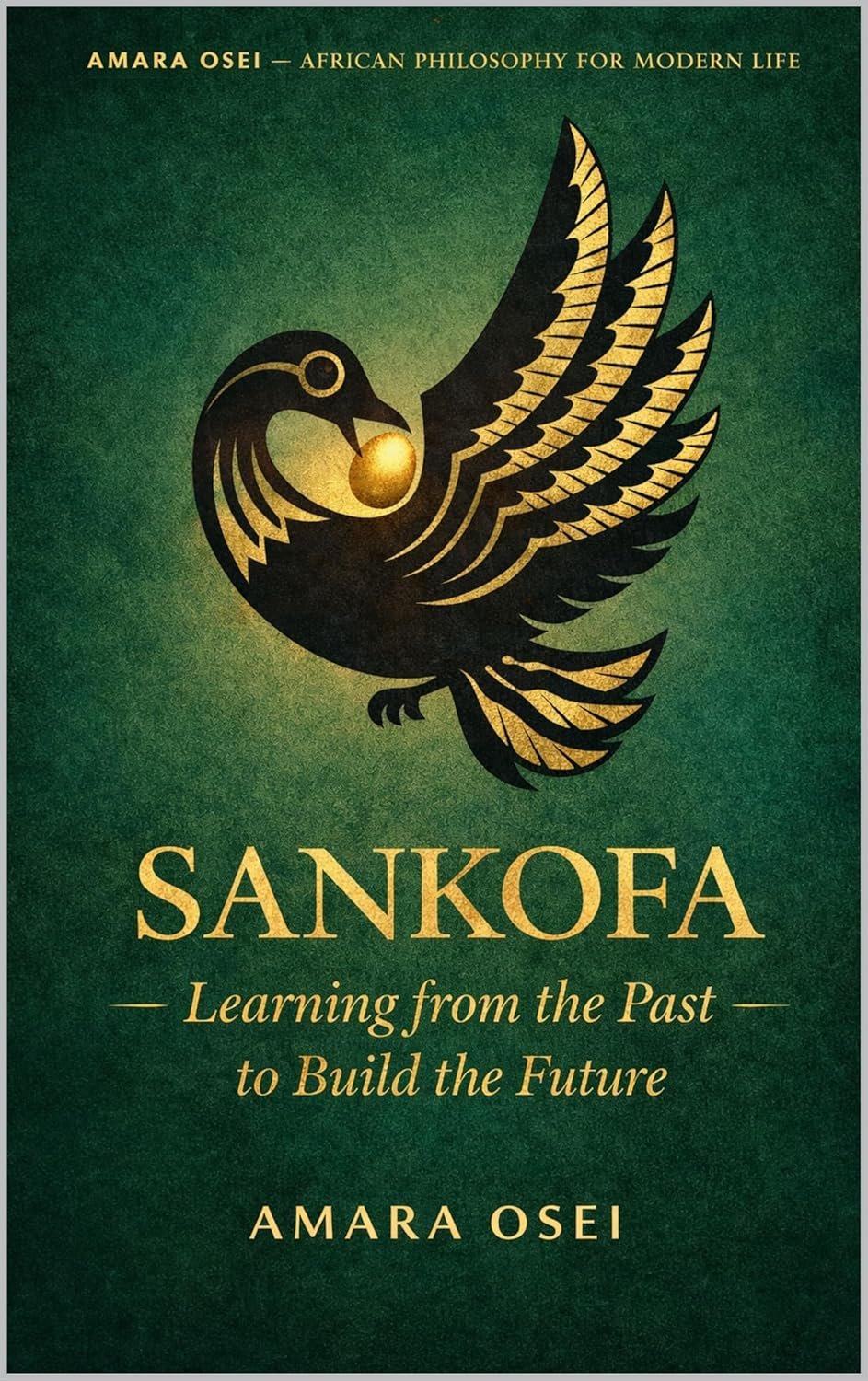
The full philosophy, as a book
How to use your history, your failures, and your traditions as fuel rather than baggage.
Read on Amazon