There is a temptation, when writing about a concept like Sankofa, to make it noble. To treat Akan / Ghanaian thought as if it were uncomplicated wisdom waiting for the modern reader to catch up. Sankofa in Negotiation? The honest answer requires resisting that flattery. Sankofa is real philosophy. It has internal tensions. It can be misused. It still rewards close reading.
What Sankofa Actually Means
Sankofa is an Akan word and a symbol — most often a bird with its head turned backward, holding an egg in its beak. The egg is the future; the head turned backward is the past. Together they teach a simple, demanding idea: it is not wrong, nor shameful, to go back and fetch what you forgot. The future cannot be built on amnesia. This much is on Wikipedia and in introductory leadership books. What is harder to find — and harder to translate — is the texture of the concept: the way Sankofa shapes a thousand small daily choices in a Akan / Ghanaian household, and how those choices accumulate into a different shape of life.
Wisdom is like a baobab tree; no one individual can embrace it.Akan
The Question This Post Is About
Negotiating with Sankofa — when to push, when to host. The question is worth taking seriously, because Sankofa is one of those concepts that loses its shape when handled carelessly — and recovers it as soon as the reader is willing to slow down and listen.
If you take Sankofa seriously at work, the first thing that has to change is the meeting. Not its agenda — its shape. Western meetings are optimised for speed and for the loudest contributor. Sankofa is optimised for something else: for the quality of decisions that hold. Quarterly retrospectives are not separate from planning — they are the first half of it. The trade-off is real. Meetings under Sankofa take longer. The decisions also unstick less often.
A Second Angle
For the person living far from Ghana, West Africa — in a city of strangers, in a flat of one, in a job that has nothing to do with the village they came from — Sankofa can feel like it belongs to someone else's life. It does not. The diasporic reading of Sankofa is not a watered-down version. It is a different test of the same idea. Quarterly retrospectives are not separate from planning — they are the first half of it.
Where the Concept Resists
There is a real risk in romanticising Sankofa. The Akan / Ghanaian traditions that produced it have always also produced internal critics — voices warning against the misuse of communal philosophy to demand conformity, to silence the young, to protect bad behaviour by elders. The honest defender of Sankofa keeps those critics at the table.
What to Do With This
If you are new to Sankofa, the most useful place to start is not with a study or a course but with a question, asked of yourself, at the end of an ordinary day: who held me up today, and whom did I hold? Sit with the answer. Do not improve it yet. The concept will deepen on its own, repeated, over weeks. This is how Sankofa actually enters a life.
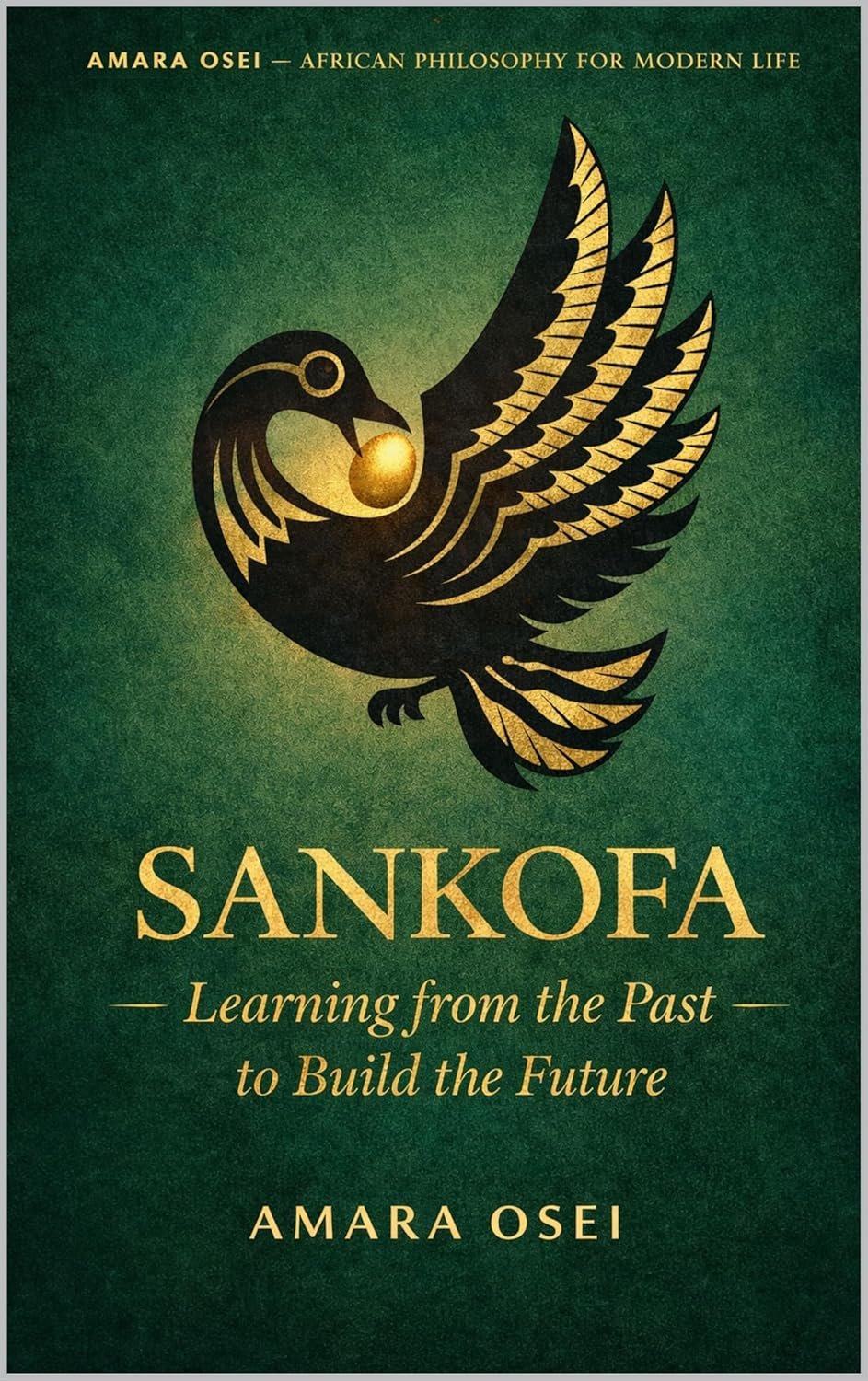
The full philosophy, as a book
How to use your history, your failures, and your traditions as fuel rather than baggage.
Read on Amazon